
Do Google Reviews Actually Matter? The Numbers That Changed My Mind
You’ve probably had this happen.
A customer leaves. They smile. They say thank you. You know it went well.
You think about asking for a review.
You don’t.
And nothing immediately breaks.
The phone still rings. The diary still fills. So it’s easy to assume reviews are helpful, but not critical.
That’s what I thought too.
Until I looked properly at what’s actually happening in the background.
Most businesses are losing customers before they even get considered
Imagine this.
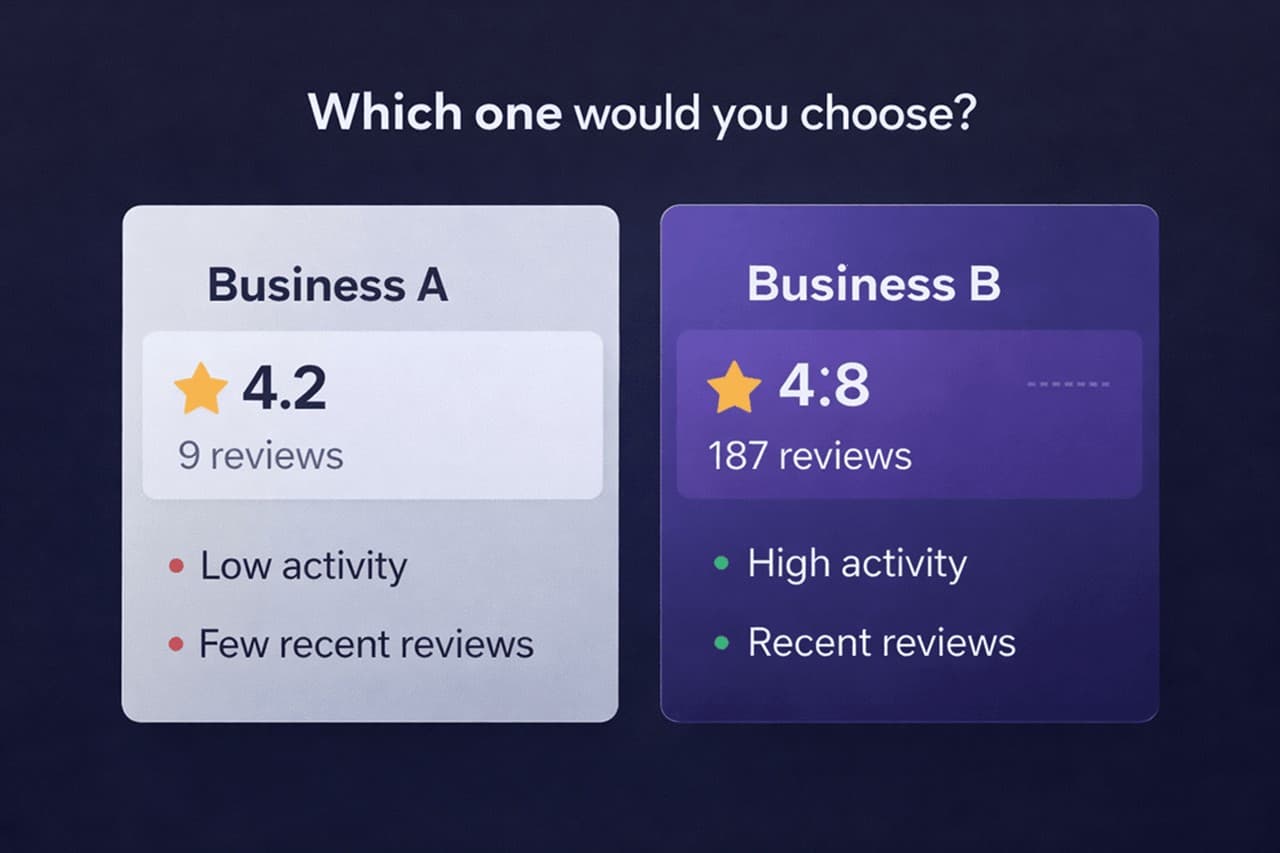
Someone searches for a dentist or physio near them. They see your name. They see two others nearby.
They don’t click your website. They don’t call you. They don’t compare services.
They look at your reviews.
Then they decide.
If you have fewer than 20 reviews, nearly half of those people will not even consider you.
If you have five or fewer, almost no one will.
That’s the part most business owners miss.
You’re not being compared. You’re being filtered out.
Quietly.
The decision is made before your website even matters
There’s a simple sequence happening now.
Search. Scan. Decide.
That’s it.
77% of patients start with reviews, not your website or an NHS listing.
And 61% now trust those reviews more than personal recommendations.
That shift matters.
Because it means your reputation is no longer something people discover later. It’s the first thing they judge.
Before they know anything about you.
Star ratings don’t just influence choice. They change revenue
There’s one stat that changed how I think about this.
Each additional star rating can increase revenue by 5 to 9 percent.
Not traffic. Not impressions. Revenue.
Put that into a real scenario.
A practice doing £400,000 a year moves from 3.8 to 4.5.
That isn’t cosmetic. It’s meaningful money over time.
And it compounds.
Businesses with 200+ reviews earn nearly twice as much as those without.
Not because reviews magically create income.
Because they change decisions at scale.
A perfect rating is not the goal
Most people assume they need a perfect 5.0.
They don’t.
In fact, a perfect score can reduce trust.
Customers don’t believe it. It feels filtered.
The highest conversion happens between roughly 4.0 and 4.7.
That range feels real.
And there’s another useful detail most people don’t expect.
Businesses with a small percentage of negative reviews often perform better than those with none.
Because it signals authenticity.
So the goal is not perfection.
It’s credibility.
The real problem is not quality. It’s consistency
Most clinics don’t have a service problem.
They have a system problem.
You’ve probably asked for reviews before.
A quick mention at the end of an appointment. A link in an email. Maybe a QR code on reception.
It works sometimes.
But not reliably.
Here’s why.
The patient leaves. They get busy. They forget.
Or they open the review page, see a blank box, and stop.
That moment is where most reviews are lost.
Not because people don’t want to help. Because the process asks too much of them.
When you don’t have a system, the wrong voices get heard
Something predictable happens when reviews are left to chance.
Happy patients say thank you in person. Unhappy ones go online.
Over time, that creates a profile that doesn’t reflect reality.
It looks weaker than it should.
And because review count and rating directly influence who gets chosen, that gap turns into lost patients.
Not occasionally.
Consistently.
The UK opportunity is bigger than most realise
This is where it gets interesting.
Only around 11% of UK dental practices have what you would call a strong review profile.
High volume. High rating. Consistent flow.
That means the vast majority are sitting in the middle.
Some reviews. No real system. No momentum.
And that creates a clear advantage for the ones who fix it.
Because once a business builds a steady review flow, it becomes very difficult for competitors to catch up.
This is where the shift happens
There’s usually a point where this clicks.
Not when you hear that reviews are important. You already know that.
It’s when you realise what they’re actually doing.
They are deciding who gets considered. They are shaping trust before a conversation happens. They are influencing revenue in a measurable way.
And all of that is happening whether you manage it or not.
What actually changes things
You don’t need hundreds of reviews overnight.
You don’t need a perfect score.
You need a system that runs consistently.
In a clinic, it usually looks like this.
After an appointment, a feedback request goes out.
The patient responds while the experience is still fresh. Their answers form the basis of a review. The hard part is already done.
I've written a complete guide on how to get Google reviews that walks through this exact process, including how to stay compliant with Google's policies and why this approach works better than traditional review requests.
No blank page. No overthinking. No “I’ll do it later”.
That’s the shift.
From hoping reviews happen to knowing they will.
Final thought
Most businesses don’t lose because they are worse.
They lose because they look worse.
And today, that difference is your Google reviews.