
How to Get Google Reviews: A Practical Guide for Businesses in 2026
Learn why customers forget to leave reviews and how to build a repeatable process that turns satisfied customers into your best marketing asset.
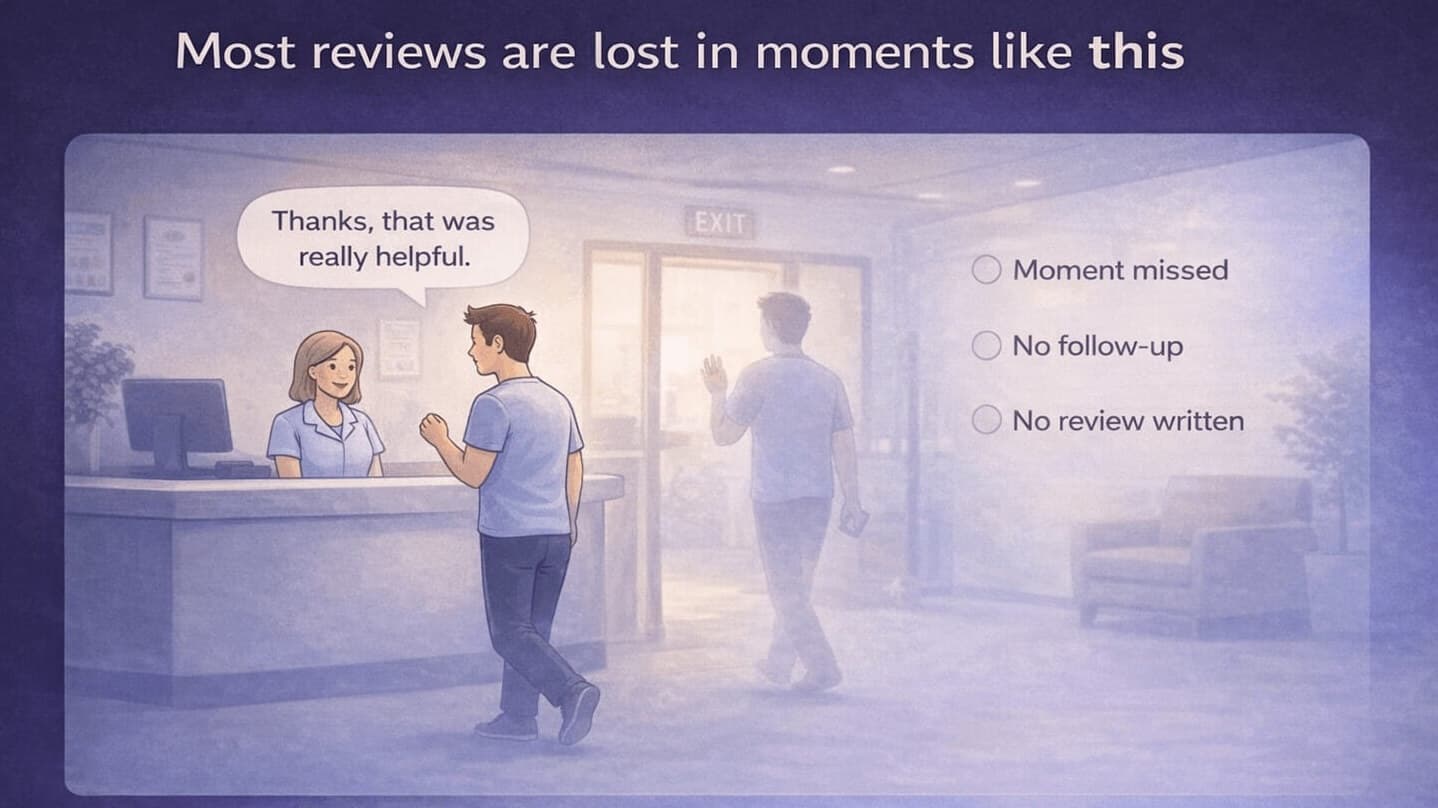
Most businesses that struggle to get Google reviews share a common assumption, if they deliver a good service, reviews will follow and their brand reputation will grow. In my experience, that assumption is often wrong and, even when it isn’t, it’s rarely enough.
Customers who have had a genuinely good experience often consider leaving a review and then simply forget or get distracted by something else. The intention is there, the problem is that the thought appears at the wrong moment. There is no easy way for them to act on it, life takes over, and the review opportunity is lost.
Many people don’t ask for reviews, this is one of the most common reasons why their business doesn’t have as many positive reviews as they deserve. They find it awkward when stood face to face with a customer, or the timing just doesn’t feel right.
Getting more Google reviews is rarely just about asking more often. It's about understanding why the gap exists between a customer intending to leave a review and actually leaving one, then building a process that closes that gap.
"Businesses are lucky to get reviews if they rely purely on delivering a good service and don’t make reviews part of their marketing strategy."
Many blog posts about this topic will include a long list of different ways to get more Google reviews. But the truth is, you don’t need a long list, you just need the most effective strategy for your type of business. If you’d like to skip to the solution click here, but if you have a few extra minutes, I’d invite you to read on from here, because understanding how and why people leave reviews, and what not to do, can help a lot too. I'd also advise you to read Google's tips on how to get more reviews.
Getting more reviews usually comes down to a few principles:
- Ask at the right time, or as close to it as possible.
- Reduce the effort involved for your customer to leave a review.
- Make it easy for customers to remember and share their experience.
- Build something repeatable rather than relying on occasional reminders.
- Don’t break Google's guidelines or Fake Engagement policy, such as buying fake reviews.
The rest of this article explores why those principles matter and why most businesses find them harder to follow than they look.
Why many businesses struggle to get Google reviews
Happy customers often intend to leave reviews
One of the most commonly misunderstood things about review generation is what actually stops customers from leaving reviews. The default assumption is that if someone hasn’t left one, they didn’t care enough or weren’t impressed enough. In most cases I’ve observed, that simply isn’t true.
![[Illustration: customer forgets to leave a review after saying yes]](/_next/image?url=%2Fimages%2Fblog%2Fmust-remember-to-leave-review.jpg&w=3840&q=75)
Customers who’ve had a genuinely good experience often do think about leaving a review. The intention is there. But when that thought appears, they’re never in the right place and are probably in a rush. They're not necessarily in front of a computer screen or their phone might be charging on the kitchen counter. They’re in the car, collecting children, heading back to work, thinking about going to the gym or buying some food for dinner. The thought appears and, because nothing makes it easy to act on it immediately or later, it passes.
An electrician finishes installing some new plug sockets. The customer says, “Great job, thank you!” yes, of course, I’ll leave you a review and genuinely means it. But as hours go by, and then days, and life takes over, it gets forgotten. That gap between good intention and actually thinking about what to write and taking action is where most reviews are lost. So what can you do as a business to help solve this. You need to put a system in place that makes it easier for your customers.
"Customers often have good intentions. The problem isn’t willingness. The problem is timing, convenience and life getting in the way."
Life gets in the way
Even when a customer says yes and plenty do when asked at the end of a haircut, a physiotherapy session or denture fitting the follow-through often doesn’t happen. Hours pass, days pass in our busy, time short society. Without a reminder and a direct link, finding the business’s Google Business Profile and writing something meaningful becomes a task that gets quietly postponed indefinitely. Unless you or your colleagues are proactive.
This isn’t indifference. It’s just the reality of how busy people live. The gap between intention and action is where most reviews quietly disappear.
Delivering a great service and having a review strategy are not the same thing. One produces satisfied customers. The other produces a record of satisfied customers that future customers can read online, when they are searching for a business just like yours.
The hidden problems that stop reviews from happening
The effort involved in writing a review
Even motivated customers can face obstacles when they are ready to write a review. One of the biggest is the blank page. Figuring out what to write that is more meaningful and descriptive than a couple of words like “Great service!”
Writing something more considered, that actually describes the experience, the outcome or the impact of the service, can take precious time, thought and effort. That mental work is easy to avoid when the customer has to find the business again, locate the review page and work out what they want to say.
I spoke with a client recently who told me they often say they’ll leave a review and never get around to it, because so many other things are happening. When they finally have a moment, they no longer feel they have the time to sit down and properly think about it or they have forgotten most of the detail. That’s not laziness. That’s just what happens because other things like work or collecting their children from school takes priority.
Most advice about getting more reviews never addresses this. The question isn’t only “will you leave a review please?” but “can you imagine sitting down and writing one right now?” For many customers, even willing ones, the honest answer is not immediately yes.
![[Illustration: reviews becoming part of a repeatable business process]](/_next/image?url=%2Fimages%2Fblog%2Ffeedback-review-journey-stepping-stones.jpg&w=3840&q=75)
Why QR codes and reception desk signs often don’t work
Physical review prompts, QR codes on counters, stickers in windows, plaques in waiting rooms are widely recommended (especially by printing companies).
In practice, they frequently fail. I’ll give you a specific example. My local dentist has a plaque on the reception desk with a QR code. When I’m standing there paying, having just had a check up or some treatment, the thing I’m thinking about most is getting out of there. I’m not looking at that plaque and thinking I’ll scan that now and leave a review, not least because they’ve just been drilling a tooth or I’m dribbling after a numbing injection and the main achievement is that it didn’t cause too much pain.
The problem with passive prompts is timing, not design. A QR code in a waiting room relies on the customer being in exactly the right frame of mind at exactly the right moment. Most of the time, they’re not. They’re thinking about paying, booking their next appointment, a potential parking ticket or getting back to work. A review request that arrives while the experience is still fresh and makes the action as easy as possible is a different proposition altogether. And this is why many businesses could benefit from a better system.
Why timing matters more than most businesses realise
The window in which a customer is most likely to leave a review is narrower than many businesses assume. Ask too soon and the experience hasn’t settled. Ask too late and it’s been displaced by everything else that has happened since. The best moment is usually when the experience is fresh but the customer has had a chance to reflect, typically within 24 to 48 hours of the service. However, it isn’t always the case. I have seen businesses have reviews written which have been requested after a few weeks. It’s not best practice and conversion is usually lower, but it can still work.
"Customers are often thinking about getting on with their day, not searching for a Google Business Profile and a review page."
Why most businesses only start thinking about reviews when sales are flat
There’s a pattern that appears, repeatedly, across businesses of all sizes. In my experience, reviews are rarely treated as a high priority until there’s a reason they can’t be ignored. A competitor opens up nearby who has more review velocity, a potential client mentions them, or someone in a meeting mentions there haven’t been any new positive reviews in months.
The conversation usually goes something like this. Reviews come up. Someone says, “We don’t have enough of them” or “Our competitors have got more.” There’s general agreement that something should be done and then the conversation moves on to the next item. No process is put in place and nobody is given ownership or responsibility for growing them. And nothing changes until the problem becomes visible enough to force action again.
This is common across many local service businesses, especially those who don’t realise how important they are to help enhance your business reputation, especially in the world of AI search. AI overviews increasingly appear to draw upon information found in online reviews to help understand businesses. So having informative reviews can help with this.
An accountant might deliver excellent work for many years without ever asking a single client for a review face to face, perhaps because it feels awkward. A freelance designer, a window cleaner, an osteopath all may have lots of genuinely satisfied clients and have almost nothing to show for it on an impartial review platform. Not because clients wouldn’t have helped, but because nobody ever built a way of asking them effectively. As a result those businesses may not have as many trust signals as some of their competitors and they are missing out on what can become an important business and marketing asset.
The issue isn’t awareness. Most businesses know reviews matter.
The problem is that reviews are often discussed, but rarely treated as a business process.
I recently spoke with a local used car dealer because I noticed they were actively publishing customer reviews on their website. I assumed they might be using specialist software or an agency. The reality was much simpler. The owner told me he personally asks every customer for a review, typically sells between five and ten cars a month, replies to reviews himself, and believes Google reviews have played an important role in helping his business grow.
Reviews and the positive impact they can have on a business’s reputation often feel like something to fix later. There are more pressing things to do. And by the time later comes, the business may have spent years serving many satisfied customers with nothing to show for it online.
"Reviews often become nobody’s responsibility. And work that belongs to everyone frequently belongs to no one."
It’s also worth noting that many businesses measure almost everything else. They track website traffic. They look at advertising spend. They know their conversion rate. But reviews? The monitoring often amounts to getting excited when a notification arrives from Google Business Profile saying a new review has come in. That’s not measurement. It’s just awareness. And it tells you nothing about whether things are improving, declining, or standing still. Even a simple spreadsheet tracking review numbers month by month can start to reveal useful patterns and trends. A professional system will be more effective, but anything is better than nothing.
"Most businesses don't have a review problem. They have a process problem."
Why asking for feedback first can work better than asking for a review
Review request versus feedback request
Most advice on this topic starts with, send a review request. Include a link. Keep it short. That approach is widely used by some agencies and software solutions and in some cases it works. But there’s a distinction worth understanding, one that most businesses never consider.
A direct review request “please leave us a review” feels, to use my own word for it, cold. It’s a one-sided request. The customer is being asked to do something that benefits the business publicly. The business is essentially saying, we know reviews matter, we want one, and we’d like you to provide it. Some customers are fine with that. But many, even satisfied ones, may find it slightly off. They came for a service. Now they’re being asked to promote it.
I recently spoke with a Private GP who told me they send emails asking patients to leave reviews after an appointment, yet very few people actually do. The email subject line simply said “Review request”. Would you open it? Most people can probably guess what the message is going to say.
![[Illustration: feedback-first review process]](/_next/image?url=%2Fimages%2Fblog%2Fasking-for-feedback-first.jpg&w=3840&q=75)
A feedback request feels different. It feels more like a conversation and less like a favour. “Please tell us how things went. Share your experience. What would you tell a friend?” The focus shifts to the customer’s perspective rather than the business’s needs. That shift is subtle but it changes the emotional weight of the request.
Why the framing of a request matters
This isn’t about being clever or manipulative. It’s about recognising that customers are often more comfortable sharing an opinion than being asked to publicly recommend a business they may have only just used.
Feedback opens a conversation. Just sending a review request can close one before it has even started.
In practice, starting with feedback and asking customers how their experience was before directing them towards a public review opportunity tends to feel more natural for both sides. It’s closer to how genuine conversations about service actually work. And when customers who’ve had a positive experience are given the space to articulate it, many of them are happy to share it more publicly.
"Starting with feedback shifts the focus from ‘help us’ to ‘tell us how things went.’"
Build a review process instead of relying on luck
Why campaigns often underdeliver
When businesses do decide to take reviews seriously, the most common response is a one off campaign. Email the whole database. Post a reminder. Ask the colleague to reach out. The number increases for a few weeks and then the campaign ends, attention moves elsewhere, and the review count flatlines again or at best trickles.
This isn't a strategy. It's a short-term reaction to a problem that keeps coming back because nobody built a proper process in the first place.
The used car dealer I mentioned earlier doesn't run review campaigns. He asks every customer, every time he makes a sale for a review. That's the difference between a campaign and a process.
What a review process actually looks like
Before worrying about process, it’s worth understanding what you already have. If a business has twenty-two reviews, the first question shouldn’t be “how do we get more?” It’s “what are these twenty-two published reviews tell us?”
- How old are they?
- What triggered them?
- How frequent are they?
- Are there themes, a staff members name?
- Are any specific services mentioned?
- What things do customers write about most?
Not all reviews are the same. A business with twenty-two short “great service” reviews is in a very different position from one with twenty-two detailed reviews mentioning staff, outcomes and specific treatments or services.
Your existing reviews are often your best source of insight. They tell you what customers noticed, what they valued and what they felt was worth mentioning. That information can be useful when refining your review process, communications and even future email subject lines.
Once you understand where you are, the goal is to put a daily or weekly process in place. Identify which customers to contact. Reach them at the right time, while the experience is still fresh. Give someone responsibility for making sure it happens consistently. Then monitor and measure the results so you can spot patterns and make better decisions over time.
Give somebody ownership
One of the most consistent reasons review strategies fail is that no one is clearly responsible for them. Reviews sometimes sit in an undefined space between customer service, marketing and operations. When something belongs to everyone, it tends to get done by no one. Someone needs to own this.
That might be the business owner. It might be a front-of-house member of staff. It doesn’t need to be complicated. But without a named person tracking review numbers week on week, noticing when things are flatlining and asking why, the process quietly stalls.
Measure review activity
Businesses routinely measure website traffic, advertising spend and conversion rates. They have strategies for PPC, strategies for SEO, strategies for content. Reviews are rarely given the same treatment. But the same logic applies. If you’re not tracking how many reviews you receive per month, whether that number is growing or declining, and how your profile compares to competitors, you have no way of knowing whether anything is working.
A monthly comparison doesn’t require sophisticated software, but software can help. Even a simple note of how many reviews arrived that month, compared to the month before, starts to tell a useful story. If the number is flatlining or declining, that’s a signal worth investigating.
Many businesses focus on their average rating, but review velocity can be just as important. A consistent stream of new reviews shows potential customers and search engines that your business is active, trusted and continuing to deliver great experiences.
For many businesses, reviews are currently an untapped marketing and business growth opportunity.
![[Illustration: measuring results of survey requests and reviews gained]](/_next/image?url=%2Fimages%2Fblog%2Fmeasure-learn-improve-grow-reviews.jpg&w=3840&q=75)
Test and learn
Review generation is an area where small tests can produce useful insights. The day and time a request is sent, the wording of the subject line, the tone of the message, all of these can affect how many customers complete a feedback survey or review.
Testing whether sending in the afternoon outperforms the morning, or whether a particular day of the week gets better responses, takes very little effort and over a few months can meaningfully improve conversion.
What works for a dentist may not work for a physiotherapist, accountant or emergency plumber, which is why testing is often more valuable than assumptions.
Practical ways to increase Google reviews
Before you read these five points, remember this: happy customers often intend to leave reviews. The problem is that intention never becomes action.
I've mentioned this earlier because it's one of the most important ideas in this guide. Your job isn't to force reviews. It's to make it easier for customers to remember and share their experience when they want to.
1. Reduce friction wherever possible
The single most effective practical step is usually the simplest, make it as easy as possible for the customer to complete a review. That means a direct link to the Google review form, not a link to your homepage, not a QR code sitting on a stand at your reception desk, but one click that opens the review page directly and at an appropriate time.
Every additional step between a customer’s intention and a completed review is an opportunity for them to stop. Reducing those steps and making it easier for them is more valuable than almost any other change.
2. Ask while the experience is fresh
Timing is one of the most important variables in review generation and one of the least discussed. In many cases a request sent within 24 to 48 hours of a service will outperform one sent a week later. The experience is still clear. The feeling is still present. The customer hasn’t moved on to ten other things. Follow-up requests can work, so don’t give up after one request, but also be respectful and don’t ask too many times.
3. Start with feedback, not a review request
One of the biggest mistakes I see is businesses jumping straight to asking for a review. In my experience, asking for feedback first often feels more natural.
A review request can feel one-sided. The business is effectively saying, "We'd like you to do something that helps us." A feedback request feels different. It asks the customer to share their experience and opinion. This approach can make customers feel more valued and listened to.
What went well? Was there anything that could have been better? Would they recommend the business to a friend?
The focus shifts from "help us market our business" to "tell us how things went".
This approach can also help businesses learn more about their customers. Positive feedback can highlight what customers value most. Less positive feedback can identify issues that need attention that you otherwise may not have been aware of.
If a customer chooses to share their experience publicly, the process should make that easy. The goal should be to understand the customer experience and learn from it, not to manipulate the outcome.
4. Test, learn and refine your process
Review generation is an area where small tests can produce useful insights. The day and time a request is sent, the wording of the subject line and the tone of the message can all affect how many customers respond.
What works for one business may not work for another. That's why testing is often more valuable than assumptions.
Try sending requests at different times of day. Experiment with different email subject lines. Monitor whether certain days of the week generate better response rates than others.
The goal isn't to constantly change your process. It's to learn what works best for your customers and then build consistency around it.
Over time, small improvements can have a meaningful impact on the number of feedback responses and reviews you receive.
5. Follow Google’s guidelines
Google prohibits offering incentives for reviews, posting fake reviews, or asking only selected customers in a way that skews the overall rating. Any review strategy should be built on the principle of making it easy for genuine customers to share honest feedback, not engineering an artificially positive profile.
Google is investing heavily in AI systems to detect fake business reviews and reviews created by fake accounts.
A small note about Googles efforts to deal with fake reviews. I occasionally see people asking online where they can buy fake reviews. My advice is simple, don't. Google continues to invest heavily in AI systems designed to detect suspicious review activity and review manipulation. Fake reviews can be expensive, they can be removed, and in serious cases they could put your Google Business Profile at risk. Building a steady flow of genuine reviews takes longer, but it's a far safer and more sustainable approach.
It's also perfectly fine to use systems and technology to save time and to help you reach out to more customers, otherwise you could end up spending your evenings and weekends sending emails and replying to all of your new reviews.
Why consistency often matters more than large numbers
Review profiles tell stories
A business with 200 reviews acquired over three years looks very different from a business with 200 reviews acquired in a single month. I think about this in terms of how I personally research businesses. When I was recently looking for a podiatrist, I found myself comparing two practices. One had 50 reviews, a couple arriving each month, the most recent from last week. The other had 100 reviews, all well-rated, but nothing in the past seven months. Without much conscious thought, I trusted the first one more. The reviews told me people are still choosing this business. The second one left me wondering what had changed.
"A steady stream of reviews often creates more trust than one big burst followed by silence."
Why customers trust steady activity
What creates trust isn’t just the number of reviews. It’s the pattern. Eight reviews in January, eight in February, eight in March, eight in April, that tells you something. People keep choosing this business. Something is consistently going right. Whereas a business that got a hundred reviews a year ago and nothing since can feel uncertain. What happened? Did they change hands? Did something go wrong?
Large review counts can even create mild suspicion when they appear as a sudden spike. If a business suddenly accumulated a hundred reviews in one month and then went quiet, it’s a reasonable question to ask whether those were genuine. Steady, organic growth over time tends to feel more credible than any large one-off burst.
Review frequency and local visibility
I looked at a case recently involving an emergency dentist in Southampton. They had 17 reviews, all gathered over the previous three months. They were appearing in the Map Pack. The businesses in positions four, five and six had 200 reviews or more. When I looked more closely at what was different about the business in the Map Pack, review velocity was the standout factor.
Google has not publicly confirmed that review velocity is a direct local ranking factor. But many local SEO experts, including Joy Hawkins in this case study have observed a probable relationship between the recency and consistency of reviews and a business’s visibility in local search results. Whether or not this is a confirmed signal, the customer trust argument alone makes consistency worth pursuing.
Why reviews may become increasingly important with the growth of AI
AI needs to get its information about your business from somewhere. It is obviously aware that the information published on your website is controlled by your business. Your services page was written by you. Your About page was written by you. Your marketing messages were written by you.
Reviews are different.
The words that customers use to describe your business, services and experiences are not controlled by you. This makes review websites an interesting and informative resource for AI to learn more about your business.
Some customers include surprisingly detailed information in their reviews. They might mention specific services, staff members, locations, outcomes or how a problem was solved. AI can also understand the sentiment behind the words they use. In simple terms, it can often work out whether somebody had a positive, negative or neutral experience.
In the past, most people focused on star ratings. Increasingly, AI can understand the words inside reviews as well.
Imagine someone is searching for an emergency dentist. Ten reviews might mention being seen quickly, same-day appointments, pain relief, friendly staff and professional treatment. That's useful information for a potential customer. It may also be useful information for an AI system trying to understand what that business is known for.
![[Illustration: customer review text helping AI understand a business]](/_next/image?url=%2Fimages%2Fblog%2Fai-reading-reviews.jpg&w=3840&q=75)
The same applies to many other industries. A physiotherapist might have reviews mentioning sports injuries and rehabilitation. An accountant might have reviews mentioning tax advice and excellent communication. A private GP might have reviews mentioning fast appointments and thorough consultations.
This doesn't mean businesses should start treating reviews as an SEO exercise. Far from it. The best reviews are still genuine reviews written by real customers about real experiences.
What may be changing is the value of those reviews. They are no longer just helping potential customers decide whether to trust a business. They may also help AI systems understand what a business does, what customers value and what experiences people are having.
If that trend continues, detailed, genuine reviews could become even more valuable over the next few years than they are today.
Frequently asked questions
Why are some customers not leaving reviews even after a great service?
Either you didn’t ask, or your customers forgot, are typically the main reasons. Happy customers often intend to leave reviews but don’t follow through because the action is easy to postpone. The thought appears at the wrong moment, there’s no direct link to make it easy, and life moves on. Making the process simpler and asking at the right time significantly increases the likelihood of success.
How quickly should I ask customers for a review?
Within 24 to 48 hours of the service is generally the most effective window. The experience is still fresh, the feeling is still present, and the customer hasn’t moved on to other things. Waiting a week or more usually results in lower response rates. Remember, it is better to ask at any time, rather than never ask!
Do recent reviews matter more than total review count?
For customer trust, yes, often considerably. A customer comparing two businesses will frequently trust the one with more recent activity, even if its total review count is lower. For local search visibility, Google has not publicly confirmed that review recency is a direct ranking factor, but many SEO experts believe it plays a role.
Can I offer incentives for Google reviews?
No. Google’s policies explicitly prohibit incentivising reviews. Businesses that offer discounts, gifts or other benefits in exchange for reviews risk having those reviews removed and may face action against their Business Profile. It is also now prohibited to incentivise staff too. One company I heard about used to pay staff members $25 for every review they helped to secure. Gain reviews based on merit not gifts or financial rewards.
Can I ask only happy customers for reviews?
Google’s guidelines prohibit you from only asking happy customers for reviews, you are supposed to give unhappy customers or customers who may not have had a perfect experience the chance to leave a review too. If you do not, then this could be considered “review gating” which is against Googles policies. Some companies truly only have happy customers who leave positive reviews, you maybe one of those businesses. If you are, well done!
Does Google use the text within reviews?
Most probably yes. I don’t work for Google, nor do Google share the details of their algorithms, but, many industry experts believe they do. It would also seem logical for Google to use resources it has built which can gather and provide unique insights about how customers view a business. Obviously, if a business has lots of short and generic reviews like “Great service!” and another has much more detailed reviews mentioning specific services, treatments, quality of work, staff members by name and customer outcomes, those reviews are likely to provide more useful information and insights.
Do Google reviews help local visibility?
Reviews are widely understood to contribute to local search performance, including Map Pack visibility. Google has acknowledged that reviews are a local ranking factor, though the precise weight of different signals isn’t published. Volume, recency, overall rating and responsiveness to reviews have all been cited as relevant.
Can Google remove reviews?
Yes. Google can and does remove reviews that violate its policies including fake reviews, reviews by people with a conflict of interest, and reviews containing prohibited content. Businesses can flag suspected violations. However, Google does not remove genuine negative reviews simply because a business objects to them. Our best advice, just get real feedback and reviews from your customers as frequently as you can.
What’s the difference between asking for feedback and asking for a review?
A review request asks a customer to publicly endorse the business, it’s business-centred. A feedback request asks the customer to share their experiences, it’s customer-centred. Customers often respond more comfortably to the latter. Starting with feedback, understanding how the experience went, and then making it easy for satisfied customers to share their thoughts publicly tends to feel more natural for both sides.
Final thoughts
Your customers often have good intentions. They leave the appointment, you finish wiring their new kitchen downlights, or you complete their VAT return whatever services your business provides and genuinely your customers intend to leave a review.
They mean it when they say yes, if you are one of the few people that ask face to face. They just don’t follow through, because the moment passes, life gets busy, and there’s no easy way to act on the thought when it finally reappears.
Businesses, for their part, usually know they should be doing more. They talk about it. They agree it matters. And then something more pressing comes along, nobody ends up being responsible, and the opportunity keeps being deferred until the gap becomes large enough to become a potential marketing or reputation management problem.
Getting more Google reviews isn’t primarily a technical challenge. It’s a process challenge. The businesses that build strong review profiles consistently are the ones that stopped waiting for reviews to happen and started building a way to earn them naturally, not as a campaign they run once, but as something that becomes part of how their business operates day to day. Don’t leave it to chance. Leave that for the next time you play Monopoly.
![[Illustration: a locksmith getting a review on his mobile phone in his van]](/_next/image?url=%2Fimages%2Fblog%2Fgetting-google-review.jpg&w=3840&q=75)
"Great businesses do not simply collect reviews. They build a process that consistently earns them."